
April 9, 2026
POS, Payment Gateways & ACH in Puerto Rico: Merchant Q&A
Straight answers for PR merchants: POS vs gateway, what ACH really costs vs cards, and which setup fits your business. Local experts, English & Spanish.
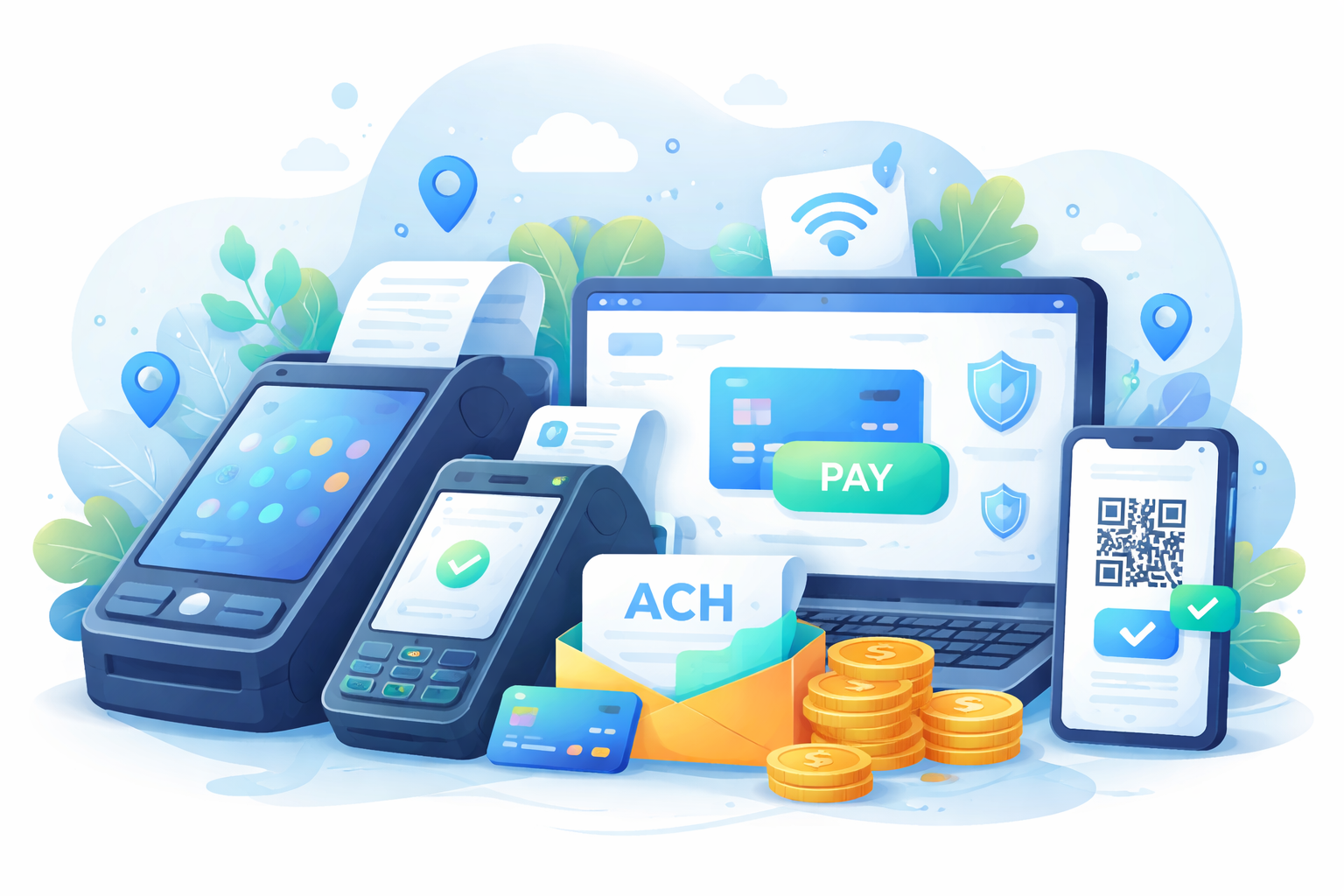
As more businesses look for better ways to accept payments, new questions continue to arise about the tools available and which option best fits each operation. In Puerto Rico, many of the most common questions revolve around POS systems, payment gateways, ACH payments, payment links, and the ability to accept payments both in person and online.
Based on a previous analysis conducted by Caribbean Payments, we have gathered some of the most frequently asked questions on this topic and answered them in a clear and practical way. The goal is to help you better understand how these solutions work and what factors are worth evaluating before making a decision.
Frequently Asked Questions
Clear answers to help you understand how POS systems, payment gateways, ACH payments, and other payment solutions work in Puerto Rico.
Q. What is the difference between a POS system, a payment gateway, and a virtual terminal?
A. A POS system is the solution that allows a business to process payments at a physical point of sale and, in many cases, also manage functions such as inventory, reports, and sales activity. A payment gateway is the technology that authorizes and connects digital payments, especially on websites, payment links, or e-commerce platforms. A virtual terminal, on the other hand, allows a business to accept payments from a computer or browser without needing a physical terminal at the counter. Although these are different tools, they can work together as part of the same payment strategy.
Q. What does a business in Puerto Rico need in order to accept payments in-store and online?
A. A business that wants to accept payments in both environments needs a solution that can support multiple payment channels. In practice, this may include a POS system for the physical location, a payment gateway for online sales, payment link options for remote transactions, and methods such as cards or ACH depending on the type of customer. The important thing is for the payment experience to be clear, secure, and easy to manage within one operation.
Q. When is it better to accept ACH, and when is it better to accept card payments?
A. ACH is often a good option for recurring payments, higher-value transactions, or bank-to-bank transfers, especially when a business wants an alternative to card processing. Card payments, on the other hand, offer speed, familiarity, and a very practical experience for immediate purchases both in-store and online. The best choice depends on the type of sale, the average ticket size, and the kind of payment experience the business wants to offer.
Q. What payment methods should a business accept today?
A. In most cases, a business should consider accepting at least cards, online payments, and some form of remote payment option such as a payment link or virtual terminal. In some cases, it is also worth adding ACH. The more useful and simple payment options a customer has, the easier it becomes to complete a sale and reduce friction in the checkout process.
Q. What should a business evaluate before choosing a payment solution?
A. Before choosing a solution, it is important to analyze how the business sells, where it accepts payments, what processing volume it handles, whether it needs reports, whether it also sells online, and how much flexibility it requires. Not every business needs the same tool. Some operations need a robust POS system, while others may need more of a payment gateway, payment links, or a combination of several options. The key is to choose a solution that supports daily operations and also allows room for growth.
Frequently Asked Questions for Retail and Commercial Businesses
What every business should know to sell more, collect payments more efficiently, and offer a faster and smoother payment experience.
Every business has different needs depending on its size, sales channels, and the type of customer experience it wants to offer. For that reason, in addition to general questions, it is also important to review some more specific questions related to payment systems in a commercial environment.
Q. What type of POS system does a business in Puerto Rico need?
A. It depends on the type of business and its daily operation. A small business may need a simple solution to process payments quickly and review sales activity, while a retail store or restaurant may require additional functions such as inventory, user controls, detailed reporting, or support for multiple checkout points. The best choice is the one that fits the real day-to-day dynamics of the business, not just a one-time need.
Q. How can a business collect payments through social media, messaging apps, or email without having a full online store?
A. A practical option is to use payment links or remote payment tools. These solutions allow the business to send a secure payment link to the customer so the transaction can be completed without the need to build a full e-commerce website. For many businesses, this model is useful when selling through social media, direct customer service, or messaging channels.
Q. Is a smart terminal, a traditional POS, or a virtual terminal the best option?
A. There is no single correct answer, because each tool solves a different need. A smart terminal may offer more features and a more modern in-store experience. A traditional POS may be appropriate for simpler or already established operations. A virtual terminal, meanwhile, is very useful when payments are processed from an office, a computer, or a remote environment. The best option is the one that best supports the way the business sells and collects payments every day.
Q. Why is it important for a business to offer multiple payment options?
A. Because payment habits are not the same for every customer. Some prefer to pay by card in-store, others prefer to receive a payment link, and others may need an option such as ACH. Offering different alternatives helps improve the customer experience, makes it easier to complete the sale, and reduces barriers during the payment process.
Q. What should a business look for in a payment solution beyond cost?
A. In addition to cost, a business should consider ease of use, security, support, integration capabilities, visibility into reporting, and adaptability across different sales channels. A payment solution should not be evaluated only by price, but by the value it brings to the operation, to business control, and to the customer experience.
Closing
We hope these answers have been helpful in providing a clearer understanding of how POS systems, digital payments, payment gateways, and ACH payments work in Puerto Rico.
If you have additional questions or would like to evaluate which solution may be the best fit for your operation, you are welcome to contact us. We will be glad to provide more specific guidance based on the needs of your business.
We also invite you to follow us to stay up to date on our upcoming blog posts, where we will continue sharing useful information about payment solutions and new frequently asked questions, including our next article on payment collections in the healthcare sector.